

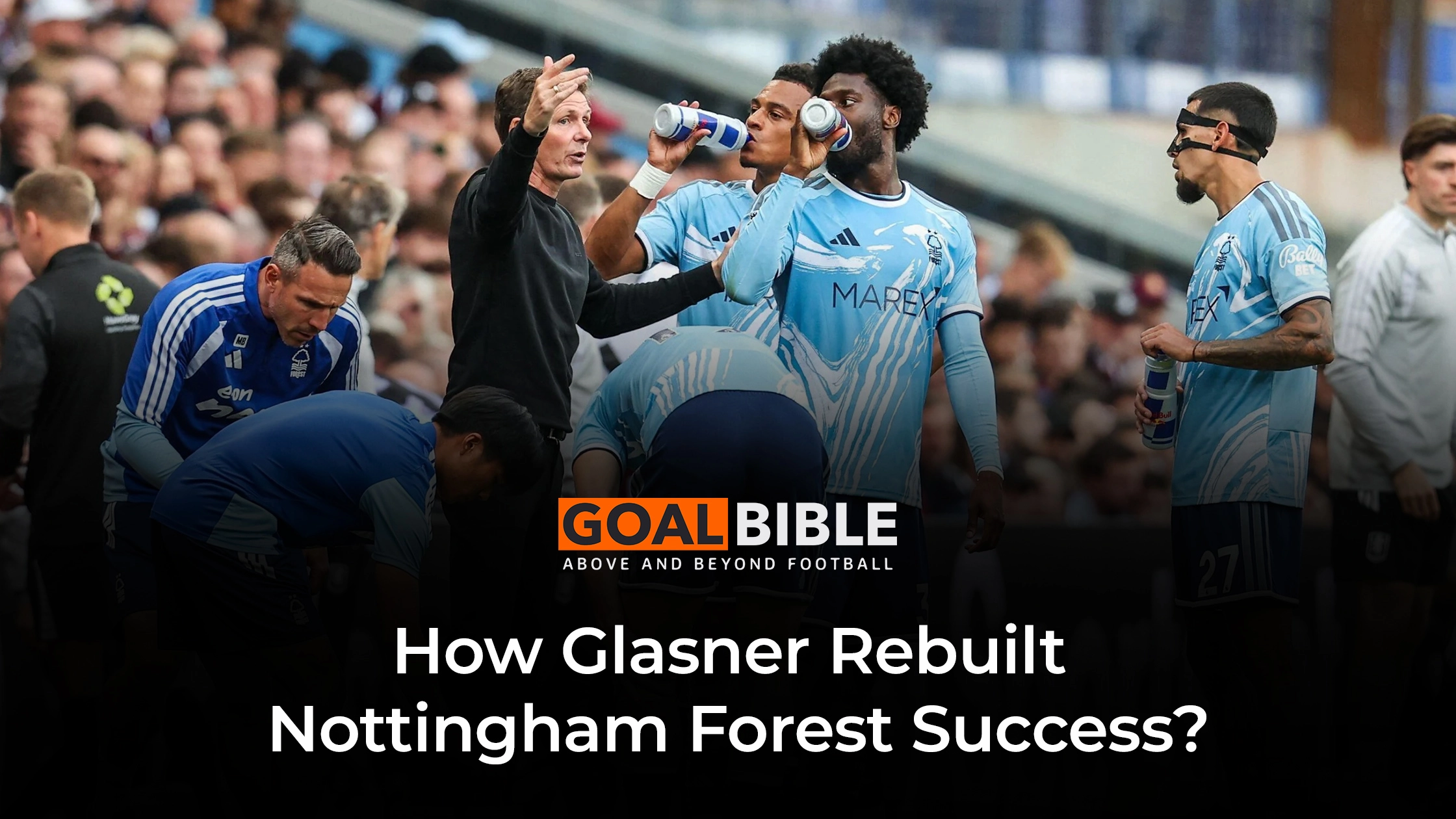
Nottingham Forest Analysis: How Is Oliver Glasner Restoring Their Recent Success?
Oliver Glasner is restoring Nottingham Forest's success in much the same way he did at Crystal Palace: keep it tight at the back, hit teams on the break, and let the attackers rotate. They lost to Leeds United first up, then drew with Liverpool and Tottenham Hotspur, then won 2-1 at Villa Park, so that is three games unbeaten and the numbers back it up too.
That is the kind of trend GoalBible tracks across the whole Premier League season, not just one weekend. Every matchday, I look at the same underlying numbers, the defensive structure, the transition speed, the finishing gap, and update where each team stands. Forest are one of the more interesting cases this season because the process is already ahead of the results.
Read More: Nottingham Forest Premier League Season Preview & Prediction
What Has Oliver Glasner Changed at Nottingham Forest?
The early picture is clear. Forest sit deep, stay compact, and hit teams in transition. They average the lowest sequence time per possession in the Premier League this season at 7.15 seconds, and the second-fewest passes per sequence at 2.76. But their direct speed of 1.91 ranks seventh in the league. So they are not slow. They are just short and sharp.
At the other end, Forest have generated 6.13 xG and scored four goals, an underperformance of -2.13. That gap will interest me all season. They rank fourth for xG difference at +1.97, which tells me the process is healthier than the scoreline suggests.
That approach has a clear precedent in Glasner's work at Crystal Palace. His side was set up in a 3-4-3 and could remain effective without dominating possession. The emphasis was on structure, compactness and making the most of transitions, which are also central to Forest's early performances under him.
When I looked at those numbers, I was surprised the finishing gap was that wide. It reminded me of Palace under Glasner in 2024, where the chances came before the goals did.
|
Metric |
Forest |
League Rank |
|
Possession % |
43.1% |
Low |
|
xGC |
4.16 |
3rd lowest |
|
Sequence time per possession |
7.15s |
Lowest |
|
Passes per sequence |
2.76 |
2nd fewest |
|
Direct speed |
1.91 |
7th |
|
xG |
6.13 |
Mid |
|
Goals scored |
4 |
Underperforming |
|
xG difference |
+1.97 |
4th |
How Does Glasner Set Up Forest Out of Possession?
Glasner has organized Forest into a 5-2-3 shape without the ball. They don't press the opposition buildup immediately. Instead, they sit in a zonal mid-block, forcing teams wide and blocking central access.
The front three block passes to the pivot while staying narrow. One or both central midfielders are ready to jump if the opposition finds their pivot. The centre-backs can also step up to close down space in front of them while protecting the area behind the midfield. This keeps the units compact.
When the ball moves wide, the inside forwards work hard to trap opponents near the touchline. The wing-backs then press actively, and the backline shuffles across. Forest's communication between the lines has been excellent, limiting gaps.
If Forest get pushed deeper, the shape becomes more of a 5-4-1. The inside forwards support against full-back and winger combinations. Combined with a desire to stop crosses and three centre-backs handling anything that comes in, Forest have a good blend for absorbing pressure in a lower block. This then fuels their attack.
Why Is the Transition Threat So Important for Nottingham Forest?
Transition threat matters because it is how Forest score. They do not control games with the ball. With 43.1% possession and the shortest sequences in the league, they cannot wear teams down over long spells. Many of their best attacks come immediately after a regain. If the transition game stalls, the goals dry up.
In basketball, defence fuels offence. Good defending creates opportunities to win the ball back and attack before opponents can reset their defensive shape. Football works the same way. Teams that defend well in a lower block naturally get chances to break quickly.
Forest were experts at this in 2024/25. They absorbed pressure and had some of the best ball carriers in the league to drive attacks the other way. Glasner's Palace side were also brilliant at this. Adam Wharton often released long balls forward from deep once possession was won, turning defence into attack in minimal actions.
With additions like Liam Delap, who excels at running in transition and battling defenders, plus players like Morgan Gibbs-White, Dan Ndoye and James McAtee who can carry the ball forward, Glasner has built a team ready to excel here. The wing-backs are also well positioned to attack space when Forest win the ball.
Forest can also create these moments through their counterpress. They look to sustain pressure inside the opposition half to force turnovers and attack against a destabilised defensive block. From what I've seen, this is where Glasner's coaching really shows. The triggers are well-drilled.
Why Does Forest's Squad Suit Glasner's System?
Former Forest winger Paul Anderson thinks Glasner has the players to make it work, though he expects it to take time. Speaking to BBC Radio Nottingham, he pointed to the flexibility of the wing-back system: it can create midfield overloads, let one striker drop deeper, or give Forest a man-to-man option against a back four.
I can see his point. Forest have the centre-backs and midfield options to give Glasner that flexibility. Anderson praised Jair Cunha and said Murillo and Nikola Milenkovic could suit the formation once fully fit. He also thinks it can give Morgan Gibbs-White and James McAtee more space, which matches the movement I've seen from them.
For me, the real question isn't whether Forest have the right players. It's how quickly they can build the understanding this system demands. Anderson stressed it needs intelligent players who can drop into different areas, combine, and cover ground, especially at wing-back. The early signs are encouraging, but this still needs time.
What Roles Do Schlager and McAtee Play?
Schlager holds, McAtee roams. Schlager provides the defensive balance in the double pivot. He stays central behind the ball, breaks up transitions, and shields the defensive line. McAtee plays beside him but pushes forward, looks for give-and-goes, and runs beyond the opposition defence. One sits, one travels.
That split gives Gibbs-White room to drop into the spaces created by McAtee's forward movement. The result is fluid movement between the two inside forwards and McAtee, which pulls the opposition press out of shape and opens solutions in attack.
What's Next for Forest and Glasner?
Forest face Coventry City this weekend. They have a good chance of heading into the international break with eight points from their opening five league games. Forest will then look to extend their unbeaten run after the international break.
Glasner has a clear plan and the results are starting to follow. If the finishing improves, Forest could surprise a few teams this season.
How Forest's Tactical Setup Shapes the odds against Coventry City:
Forest's tactical setup gives us an interesting starting point for looking at the Coventry City market. Their compact defensive shape, low possession, and transition-based approach all point towards a game where the match result and total goals markets are worth examining.
|
Market |
|||
|
1x2 – Nottingham Forest |
1.75 |
1.60 |
1.71 |
Forest have taken 5 points from 4 home games without losing, while Coventry have lost all 4, sit on 0 points, and carry a -10 goal difference. For me, that makes the match-winner market pretty straightforward: Gembet and DK88 both price Forest at 1.75 and 1.71, while 22Bet is shorter at 1.60, so I'd lean toward Gembet and DK88 for the better return on the same outcome.
|
Market |
|||
|
Under 2.5 goals |
2.00 |
1.95 |
2.00 |
On Under 2.5 goals, I am mentally preparing you for a low-scoring match. Forest have scored more than once in only 1 of their last 3 matches, and Coventry's -10 goal difference suggests they won't be contributing much from now on. Gembet and DK88 again lead at 2.00, with 22Bet just behind at 1.95. If I were building a parlay around a controlled Forest win, Under 2.5 is the leg I'd add.

About the Author
Dan - GoalBible Maestro
Sports Betting Odds Analyst
I spent 8 years inside the Asian sportsbook industry — first as a Sports Trader at Opus Gaming Software Ltd in Makati, then as promoted to Event Settler / Live Sports Trader, and eventually became the Senior Sports Trader & Risk Manager at Offside Gaming in Philippines. In that time, I watched tens of thousands of lines get set, moved, and exploited. I saw which bettors the books respected and which ones they didn't. I learned that the market tells you something every single day.
More articles by Dan - GoalBible Maestro