

Manchester United Analysis: They Create Enough Chances, So Why Aren't They Winning?
Manchester United's problem isn't chance creation. After five matches, they rank first in the Premier League for touches in the opposition box (182) yet sit 12th with just one win. The real issue lies in shot execution and sustained pressure. Their expected goals drop dramatically after shots are taken, revealing a finishing quality problem rather than a creativity one. When I looked at those post-shot numbers, I was surprised by how stark the drop really is. United are getting into the right areas, but the final action keeps letting them down. That is a fixable problem, and one Carrick will be eager to address quickly.
We already gave a detailed preview about the Manchester United squad before the season started and I can say, we are always right.
Where Is Man Utd’s Attack Falling Short?
The problem lies less in getting into dangerous areas and more in turning those positions into high-quality shots and goals. United are reaching the final third and opposition box often enough, but their attacking sequences are too frequently ending with poor execution rather than genuine danger.
When I first pulled up United's territorial stats this season from Opta Analyst, I did a double take. They have recorded 182 touches in the opposition box. That's the highest figure in the Premier League. Their opponents, meanwhile, have managed just 92 touches inside United's box, the fewest of any team.
That creates a contradiction that's hard to ignore. United are 12th in the table, yet first for touches in the opposition box. They have one win, yet their territorial numbers suggest a side that regularly gets close to goal.
So what's actually going wrong?
|
Rank |
Team |
Expected Goals (xG) |
|
1 |
Brighton and Hove Albion |
9.7 |
|
2 |
Manchester United |
9.6 |
|
3 |
Sunderland |
9.3 |
|
4 |
Manchester City |
9.2 |
|
5 |
Liverpool |
8.8 |
|
6 |
Brentford |
8.4 |
|
7 |
Arsenal |
7.9 |
|
8 |
Fulham |
7.5 |
|
9 |
Chelsea |
7.1 |
|
10 |
Nottingham Forest |
7.0 |
The answer isn't that Manchester United cannot create chances. It's what they do once they create them. Several reasons explain why United's poor start should not simply be blamed on a lack of creativity. They currently rank second in the Premier League for expected goals with 9.6 xG, behind only Brighton. They're also sixth for big chances with 15, fifth for shots worth at least 0.15 xG with 15, and fifth for shots worth at least 0.20 xG with 11.
Those numbers are difficult to reconcile with the idea that United simply aren't creating enough. Creating a promising opportunity and turning that opportunity into a dangerous shot are two different things, though.
There have already been several clear examples of this. Bruno Fernandes hit the post against Fulham, while Bryan Mbeumo missed a late opportunity against Manchester City. On the opening weekend against Hull City, Patrick Dorgu failed to convert a back-post opportunity and Mbeumo also missed a chance during a fast break. Individually, United also have two players among the Premier League's top three for chances created.
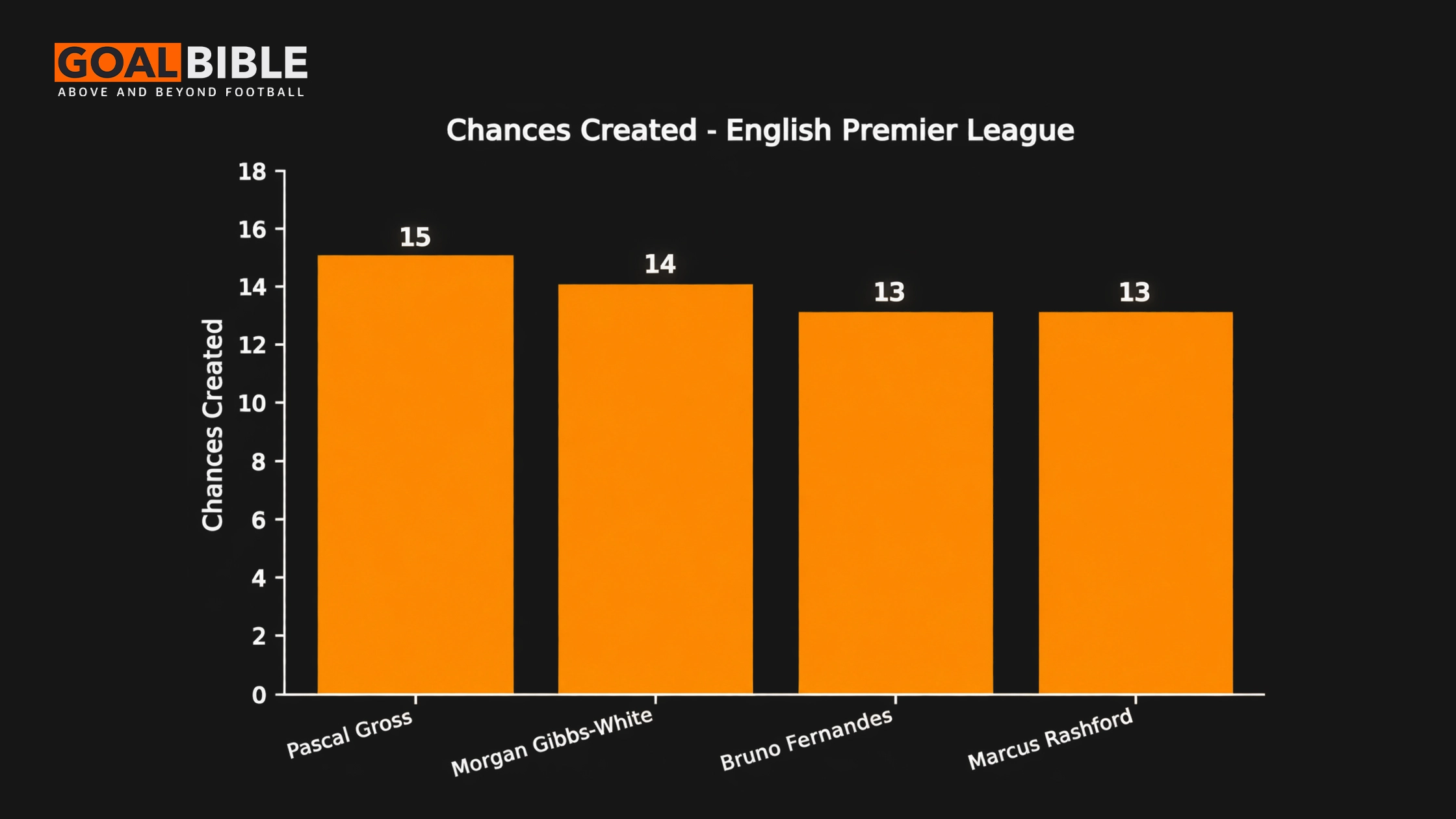
In other words, there's enough evidence to suggest that the supply isn't the fundamental problem. United are getting into good positions. They're getting the ball into the opposition box. They're creating chances. But the final action isn't matching the quality of the opportunity.
Are Man Utd Turning Good Chances Into Good Shots?
Not consistently. United are creating good opportunities, but their shots are often failing to match the quality of those chances. Manchester United's 9.6 xG drops to just 6.4 post-shot xG. That distinction matters. xG measures the quality of the opportunity before the shot is taken. Post-shot xG also considers the quality and placement of the actual shot. United's difference of -3.2 between xG and post-shot xG is the worst in the Premier League.
So it's not like they're just missing a few good chances. They keep failing to turn good moments into real shots. The ball might get into a dangerous spot, but the final touch, the decision, how they shape up or where they put the shot often just ruins it before the keeper has to make a real save.
That's a much more specific problem than simply saying "Manchester United need better finishing." It points towards shot execution.
The big-chance numbers reinforce the point. United have created 15 big chances, good enough for sixth in the league, but they've also missed 10, fifth-most in the Premier League. Interestingly, their big-chance conversion rate is 33%, slightly above the league average of 32%.
That's why the issue cannot be attributed solely to the forwards. United's problem is broader. They're not consistently making the most of the situations they create.
What Did the Fulham Match Reveal About Man Utd's Attacking Issues?
The 1-1 draw at Fulham provides an excellent example of both sides of the argument. In the first half, United registered 17 shots, but only two were on target, producing just 1.03 xG. The shot count looks impressive at first glance. The actual threat was much less convincing. That's almost a perfect snapshot of United's season so far: plenty of attacking activity, but not enough quality at the end of it.
And yet Fulham also exposed a problem that the finishing statistics cannot explain on their own.
After the start of the second half, United went through an 18-minute spell without registering a single shot. They also failed to win possession in the final third during that period. Instead, Fulham were allowed to circulate possession with very little pressure, while United's own attacks became slow and predictable.
Eventually, that lack of intensity was punished. Calvin Bassey won the ball from Matheus Cunha, drove forward and fired a low effort from the edge of the box. The shot was deflected into Lisandro Martinez, who could not avoid diverting it beyond Senne Lammens.
Suddenly, a game United had controlled in territory for long periods was slipping away. Cunha's late equaliser eventually rescued a point, but it shouldn't disguise what happened before it. The goal itself was heavily deflected, and United rarely looked capable of producing a sustained attacking threat before the final stages.
That's an important distinction. United can create chances. But they cannot yet be trusted to create pressure consistently for 90 minutes.
Why Is Michael Carrick Facing a Different Challenge This Season?
Because United are now being asked to control games against deeper, more organised defences rather than relying primarily on transitions. Michael Carrick's first spell in charge of United showed that he could win games without necessarily dominating possession.
His arrival at Old Trafford in January came with a noticeably different approach. Instead of the slow, possession-heavy football from his best Middlesbrough sides, he set United up to be more direct. They beat Manchester City 2-0 despite having only 32% possession, generating 2.3 xG compared with City's 0.5. Then came a 3-2 win at Arsenal with 44% possession. He also beat Tottenham 2-0, Chelsea 1-0 and Liverpool 3-2.
That approach made sense. Rather than insisting on controlling every game through possession, United could exploit transitions and attack the space left by stronger opponents.
The problem this season is that they're increasingly being asked to do something different. They're facing low defensive blocks far more frequently, averaging 48.5 such situations per game compared with 26.5 last season. That's a completely different attacking challenge.
It's easier to create dangerous situations in transition because the opposition is already stretched. Against a settled defence, however, United need more than individual moments. They need movement. They need tempo. They need combinations between the lines. And, most importantly, they need to sustain pressure after the first attack breaks down. This is where United currently look vulnerable.
Our Conclusion? Buy a striker that converts.
Manchester United's problem is not simply a lack of creativity or poor finishing. They are getting into the right areas, but too often fail to convert chances into real goals under pressure and decisive actions. I can agree that they need a clinical striker.
The encouraging part is that the foundations are there. If United can improve their attacking structure against deeper defences and convert a greater proportion of the chances they create, their results should eventually align more closely with their underlying numbers.
How Manchester United's Attacking Numbers Shape the Odds against Tottenham Hotspur
Manchester United's underlying attacking numbers give us a strong starting point for assessing the goals market against Tottenham Hotspur. If you are comparing prices across bookmakers, J8DE currently offers the highest odds among the operators reviewed.
|
Market |
96.com Best Odds |
Baji - Best Odds (BTi Sports) |
|
|
Manchester United over 1.5 team goals |
Note: Odds are accurate as of 7 Oct 2026.
The over 1.5 team-goal market is worth a look because United's attacking output gives them so many chances to get there. Tottenham's defensive record leaves room for the hosts to capitalise too. FootyStats has United exceeding 10.5 team shots in all five league matches this season, with 80% also clearing 15.5. That makes a two-goal return more likely than recent results alone would suggest. Tottenham have also had trouble keeping opponents out, so sustained United pressure should eventually produce goals. The key thing here is that United do not have to win. Even a 2-2 draw cashes the bet. Given how poor their finishing has been, a small improvement in conversion could be all it takes to push past 1.5.
|
Market |
J8DE - Best Odds (CMD368) |
96.com Best Odds |
Baji - Best Odds (BTi Sports) |
|
Manchester United -0.75 Asian Handicap |
Note: Odds are accurate as of 7 Oct 2026.
I prefer the -0.75 line over a straight United win here. Tottenham's attack has been almost non-existent, so United do not really need to be brilliant defensively to keep control. Spurs are scoring just 0.4 goals per game, meaning even a single United goal could be enough to hold them off. That said, United's finishing has been inconsistent enough that a comfortable victory is no sure thing, which is why a heavier handicap adds risk you do not need. With -0.75, a one-goal United win gets you a half-win, and a two-goal win pays out fully. For a match where United are clearly the better side but a tight scoreline is still realistic, that feels like the right balance.

About the Author
Dan - GoalBible Maestro
Sports Betting Odds Analyst
I spent 8 years inside the Asian sportsbook industry — first as a Sports Trader at Opus Gaming Software Ltd in Makati, then as promoted to Event Settler / Live Sports Trader, and eventually became the Senior Sports Trader & Risk Manager at Offside Gaming in Philippines. In that time, I watched tens of thousands of lines get set, moved, and exploited. I saw which bettors the books respected and which ones they didn't. I learned that the market tells you something every single day.
More articles by Dan - GoalBible Maestro