


Manchester City's Two-Game Losing Streak: Five Tactical Issues Behind Their Sudden Decline in 26/27
I did not expect to be writing about a Manchester City wobble this early, but here we are. Manchester City's perfect start to the Premier League season has suddenly lost its momentum. Seven straight wins under Enzo Maresca had everyone relaxed. Then Aston Villa won 2-1, Brighton won 1-0, and the mood flipped fast.
What makes these defeats particularly concerning is that City's problems cannot simply be attributed to poor finishing or individual mistakes. Although they have continued to dominate possession and create opportunities, there are noticeable changes in how they approach games and how effectively they control them.
So I compared the first seven matches with those two defeats, and five clear problems emerged that help explain City's sudden decline.
1. From Ruthless to Wasteful: City's Declining Attacking Efficiency
One of the biggest surprises from City's recent defeats is how significantly their goalscoring output has declined despite producing more attacking opportunities.
|
Attacking statistics |
First 7 games |
Last 2 games |
|
Goals per match |
2.71 |
0.50 |
|
Shots per match |
14.57 |
18.00 |
|
Chances created per match |
11.29 |
16.00 |
|
Big chances per match |
3.57 |
3.50 |
The numbers suggest that City are not necessarily struggling to get into dangerous positions. In fact, they are creating more chances and attempting more shots than they did during their winning run. However, their ability to convert those opportunities into goals has deteriorated considerably.
Erling Haaland's recent performances illustrate this problem. Across the defeats against Aston Villa and Brighton, he registered seven shots but scored only once. The big chance he missed against Brighton was particularly frustrating, considering how important such opportunities can be in tight matches.
I do not believe City's attacking problems are entirely down to Haaland, though. Opposition goalkeepers deserve considerable credit. Bart Verbruggen and Zion Suzuki made a combined 13 saves across the two defeats, demonstrating that City were still capable of testing their opponents.
Nevertheless, a team with City's attacking quality should be doing more with the opportunities available. Creating chances is only one part of attacking football; converting them consistently is what separates dominant performances from winning ones.
2. Individual Brilliance Over Collective Build-up: The Breakdown of City's Attacking Structure
City's finishing is not the only thing bothering me. I am just as worried about how they are building attacks in the first place. They kept 64% of the ball against Aston Villa and 62% against Brighton, yet their completed passes per match fell from 568.43 to 503, while attempted take-ons jumped from 19.43 to 35.
To me that points to a more individual approach. Jeremy Doku, Rayan Cherki and Iliman Ndiaye behind Haaland give City plenty of skill and creativity, but three players who all love to receive the ball and run at defenders can throw the attack out of shape.
The Villa game showed it clearly. Doku completed nine dribbles, Cherki and Ndiaye added four between them, and none of the three completed more than 27 passes.
I get why dribbling matters, especially against a packed defence, since Doku can open things up in ways passing cannot. But when individual actions take over, City's attacks become harder for their own teammates to read than for the opposition.
3. Defensive Fragility: Why City Are Becoming Easier to Break Down
While City's attacking efficiency has declined, their defensive performances have also become increasingly worrying. After nine Premier League matches, City have conceded 10 goals. That is twice Arsenal's total and more than several other teams, including Brighton, Liverpool and Everton.
|
Team |
Goals conceded |
|
5 |
|
|
7 |
|
|
8 |
|
|
9 |
|
|
9 |
|
|
9 |
|
|
Manchester City |
10 |
Source: Opta Analyst
The situation has become worse across the last two matches, with City conceding 50% more shots than during their opening seven fixtures. The same increase applies to shots conceded from inside the penalty area.
What concerns me most is that these problems involve both individual mistakes and a lack of defensive concentration. Against Aston Villa, Marc Guehi's poor decision in possession contributed to Nicolas Jackson's first goal. However, Gianluigi Donnarumma also deserves criticism. He was beaten at his near post after allowing Jackson's relatively tame effort to slip underneath him for Villa's winner.
Donnarumma's statistics further highlight his recent decline. His save percentage dropped from 72.41% across the opening seven matches to 67.65% across the last two.
Brighton's winning goal exposed another defensive weakness. Diego Gomez's cross entered the penalty area without an effective defensive response, while Matheus Nunes' mistake allowed Maxim De Cuyper to set up Yasin Ayari for a straightforward finish.
I would not place the entire responsibility on individual players, however. When similar defensive problems appear across consecutive matches, it becomes necessary to examine the organisation of the entire defensive unit.
4. The Midfield Puzzle: Finding the Right Balance Between Control and Creativity
Source: FotMob
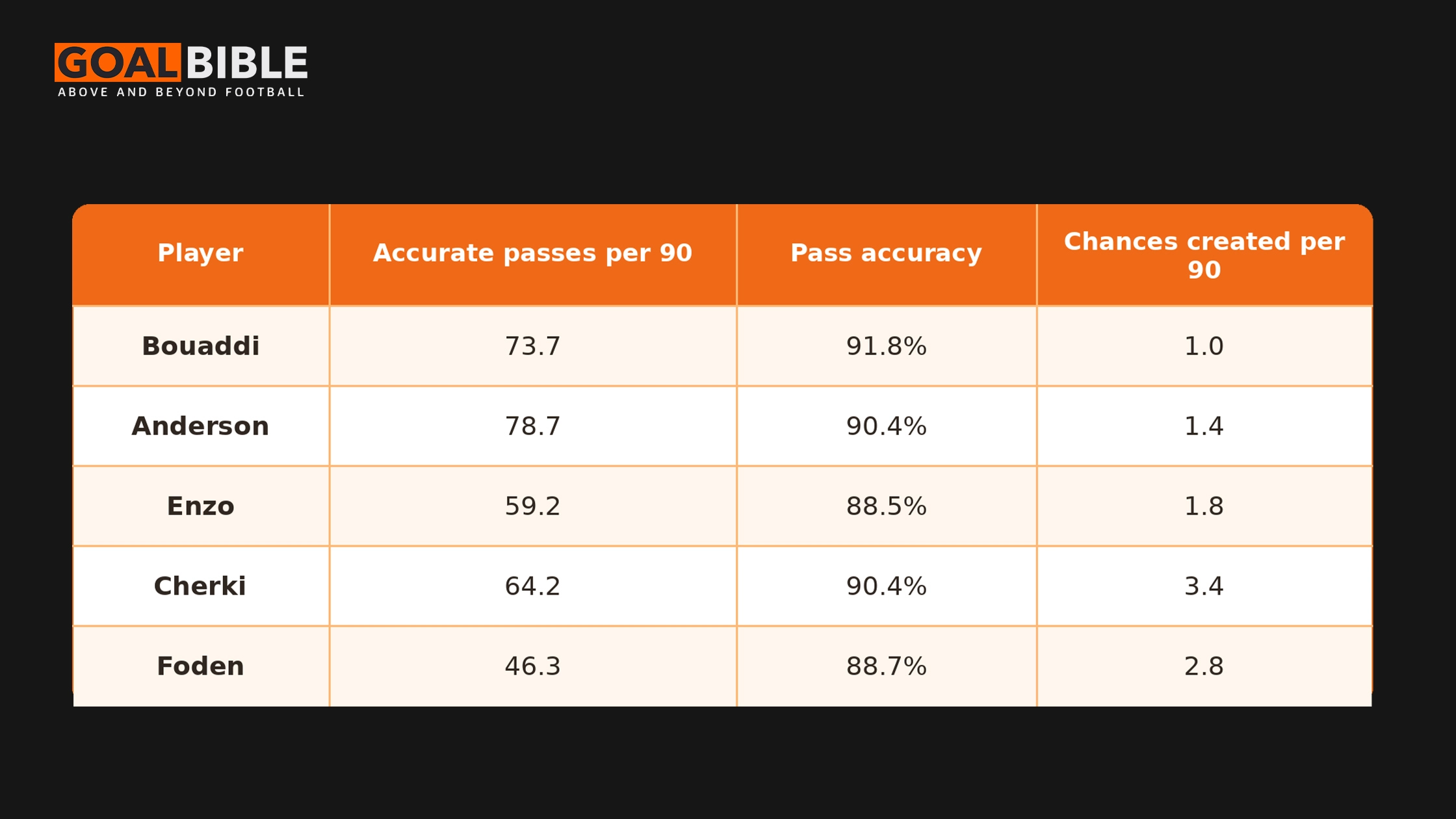
Another major issue I have identified is Maresca's difficulty in finding the right midfield combination.
Against Brighton, City started with Ayyoub Bouaddi, Elliot Anderson and Enzo Fernandez. On paper, this looked like an interesting combination, offering a mixture of defensive security, energy and technical quality. Unfortunately, their individual roles didn't produce the overall impact I expected.
Bouaddi was deployed in a more advanced midfield position rather than his preferred number six role. Anderson performed well in his usual all-action style, while Fernandez struggled to influence the game from a deeper position instead of operating as the more advanced midfielder.
For me, the solution is not necessarily to abandon this combination, but to use the players in roles that better suit their strengths.
Anderson should remain a regular starter because he can contribute across different areas of midfield. However, the question is who should partner him.
I would like to see Bouaddi given a proper opportunity as a number six. His positioning in front of the defence could provide the midfield security that City have lacked, allowing Anderson to contribute more freely without leaving too much responsibility on the defensive side.
Ahead of them, I believe either Cherki or Phil Foden should occupy the number ten position. Both offer the creativity and attacking influence needed to connect midfield with Haaland and the wider attacking players.
My preferred combination would therefore be Anderson and Bouaddi behind Cherki or Foden. Fernandez remains an alternative, particularly if Maresca wants a different technical profile in midfield. However, I believe City should first establish a consistent midfield structure rather than continually changing players' positions.
5. Beyond the Pitch: Injuries, Pressure and the Psychological Impact on City
Finally, I believe it would be unfair to assess City's recent struggles entirely through tactical performances without considering the circumstances surrounding the club.
Antoine Semenyo's absence has been another setback. Before his injury, he had shown encouraging form, scoring twice and providing an assist against Sunderland while also contributing assists against Coventry. His absence reduces Maresca's attacking options and removes a player who had been directly contributing to City's goals.
There is also the wider uncertainty surrounding City's financial case. The possibility of significant sporting consequences adds another layer of uncertainty surrounding the club. Although there is no concrete evidence that this situation has directly affected the players' performances, I believe it is reasonable to consider whether the uncertainty could create additional pressure.
Confidence is another thing worth keeping an eye on. Seven straight wins would have given City real momentum going into those two matches, but back-to-back defeats have quickly changed the mood, especially as individual mistakes and missed chances become more noticeable.
Well, I think Maresca's job now is to keep the players focused on their football instead of letting everything around them become a distraction.
Why Should We Not Give Up on Manchester City After Two Defeats?
I am not writing Maresca off after two defeats. Those seven straight wins showed a City side that could dominate the ball, create chances and control matches. The finishing, defensive organisation and midfield balance have been poor lately, but those are fixable with tactical adjustments.
I would rather give him time to find answers than judge him on two bad results. Nottingham Forest and Fulham are next, and those games give City a real chance to respond. What matters in the end is not whether he avoids every setback, but whether he learns from these defeats, adjusts his approach and gets City back to the level they showed in those first seven games.
Will Manchester City's Recent Struggles Affect Their Clash With Nottingham Forest?
Taking all of that into account, I have looked at a few markets I would consider for the Nottingham Forest vs Manchester City match, based on how City have handled pressure and how Forest have struggled at home.
|
Market |
|||
|
Manchester City – Draw No Bet |
Note: Odds are accurate as of 3 Nov 2026.
I am going with Draw No Bet rather than a straight City win, and the reason is simple. City's two defeats showed they can leak points from defensive mistakes even when they control possession. The consistency gap still favours them, with 21 points from nine games against Forest's six, and Forest have not won at home yet, drawing one and losing three. Draw No Bet gives me some protection if Forest sit deep and frustrate City's attacking efforts.
|
Market |
UEA8 Best Odds (SBOBET) |
BK8 Best Odds (Saba Sports) |
Duelbits Best Odds |
|
Total Under 2.5 Goals |
Note: Odds are accurate as of 3 Nov 2026.
According to FBref's Premier League shooting statistics, City's opponents have registered just 95 shots across nine matches, averaging 10.56 per game. Interestingly, only Nottingham Forest (9.78) and Bournemouth (10.44) have allowed fewer opposition shots in the league. This is particularly relevant ahead of this fixture, as Forest have also demonstrated an ability to restrict their opponents' shooting opportunities. With both sides showing an ability to limit shot volume, I believe clear attacking opportunities could be restricted at both ends. Despite City's recent defensive mistakes, they remain effective at restricting opposition attempts. If both teams maintain this defensive approach, a high-scoring encounter becomes less likely, making Under 2.5 Goals a selection worth considering.

About the Author
Dan - GoalBible Maestro
Sports Betting Odds Analyst
I spent 8 years inside the Asian sportsbook industry — first as a Sports Trader at Opus Gaming Software Ltd in Makati, then as promoted to Event Settler / Live Sports Trader, and eventually became the Senior Sports Trader & Risk Manager at Offside Gaming in Philippines. In that time, I watched tens of thousands of lines get set, moved, and exploited. I saw which bettors the books respected and which ones they didn't. I learned that the market tells you something every single day.
More articles by Dan - GoalBible Maestro