


Arsenal Analysis: Did Arsenal Really Need to Buy a Left-Sided Superstar?
No, and the title they just won proves it. Arsenal lifted the trophy without a world-class left-sided attacker, and the data shows their attacks were never built around that flank.
The problem with being as good as Arsenal is that improving becomes genuinely difficult. Few teams will have sympathy. Rivals who spent hundreds of millions this summer, scrambling to claw their way back into relevance, will not want to hear about how the reigning champions struggled to find players who could actually improve their first team.
That is not entirely fair, of course. Arsenal did bring in Christos Tzolis, Ezri Konsa, and Bruno Guimarães, and each has already contributed in some meaningful way. Tzolis has slotted in seamlessly on the left flank. But he was relatively unknown when he arrived, and he has yet to prove himself consistently at Premier League level. The early signs are promising. That is all they are so far.
With Leandro Trossard and Gabriel Martinelli both departing, much of the transfer-window narrative around Arsenal focused on their unsuccessful hunt for a star name on the left wing. There was talk of a serious move for Vinícius Júnior. Arsenal were outpriced for Morgan Rogers and Bradley Barcola, both of whom moved to Premier League rivals. There was persisting a little too long with faint hopes of convincing Julián Álvarez to join, though he is not really a left winger and may never have played there for Arsenal even if he had signed.
In the end, many observers felt Arsenal were left short. If they were going to slip up this season, a failure to land a world-beating left-sided forward would have been high on the post-mortem agendas across the internet.
But here is the thing. Arsenal had just won the title without, it can probably be agreed, a world-class left-sided attacker. Martinelli and Trossard are both very decent forwards, good enough to play significant roles and make key contributions for the eventual champions. They were not, however, the focus of Arsenal's attacks.
When I looked at how Arsenal actually built their title-winning campaign, the answer was sitting right there on the right side of the pitch.
Read More: Arsenal 2026/27 Season Preview & Premier League Predictions
How Right-Heavy Are Arsenal's Attacks?
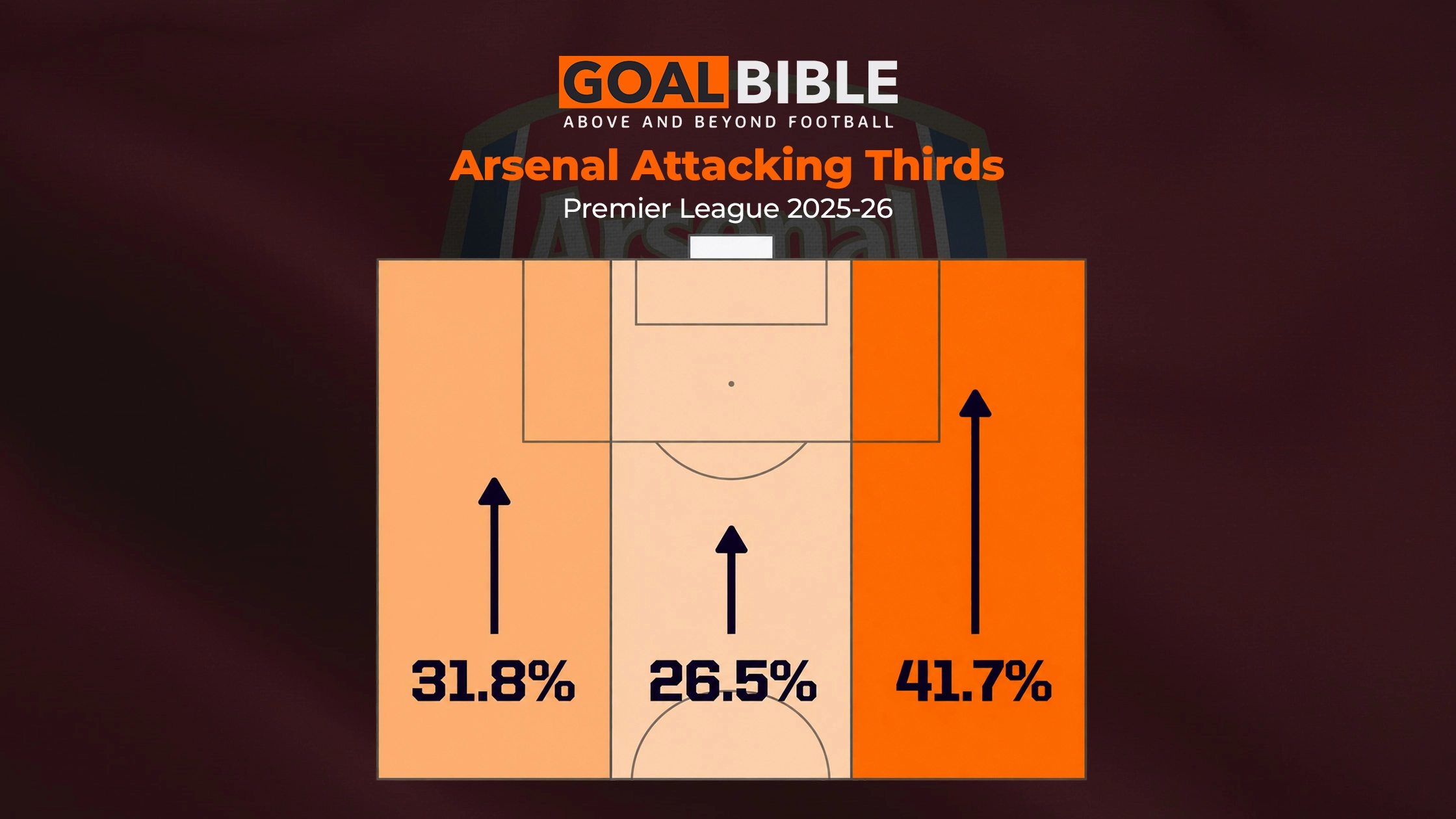
Arsenal are the most right-heavy team in the Premier League. Last season, only 31.8% of their touches in the opposition half came in the left third of the pitch, the lowest in the league, according to Opta Analyst. This term, 47.5% of their attacking touches have gone down the right, again the highest, against just 27.4% on the left.
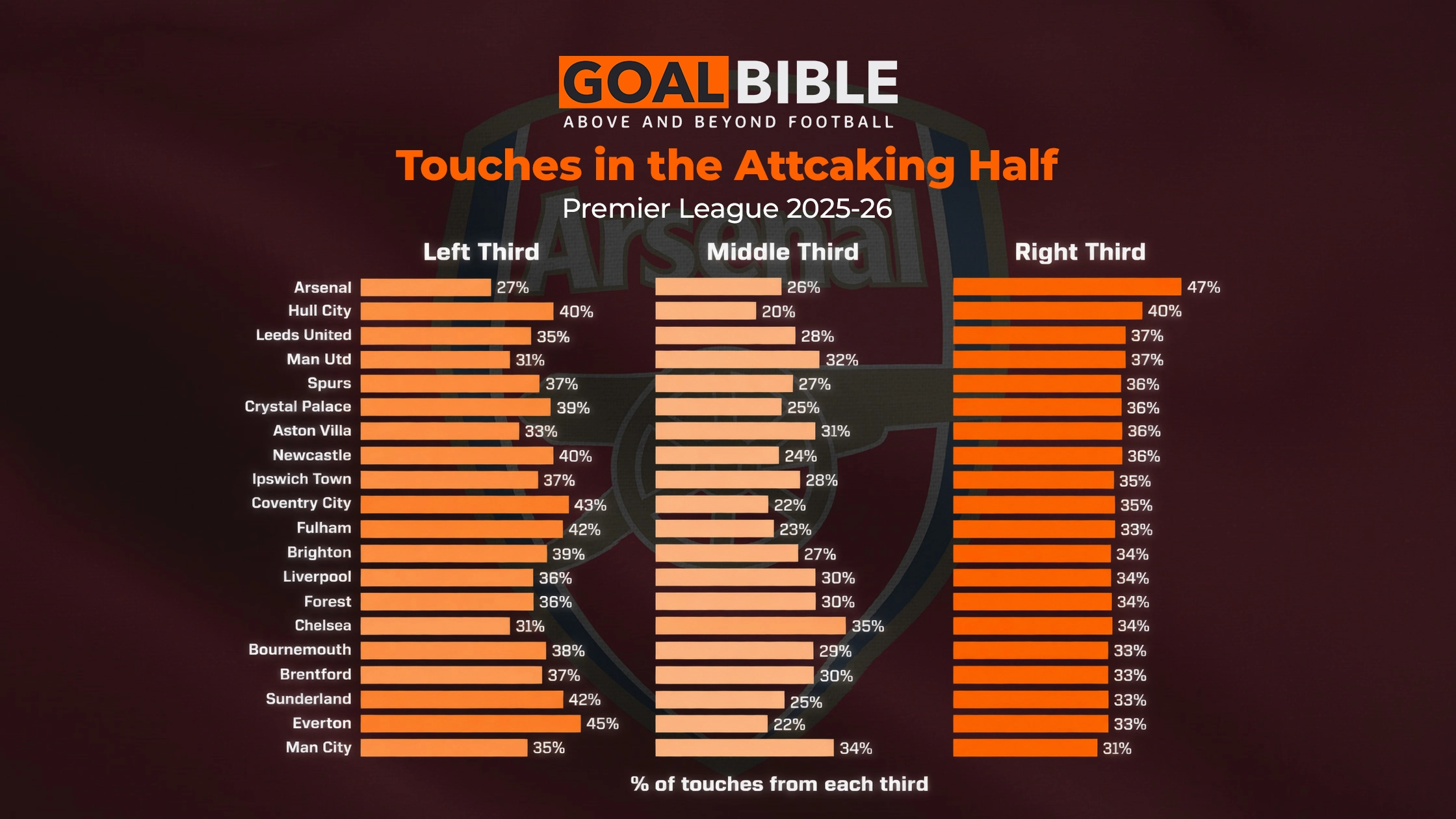
On the other flank, they already have a genuine superstar in Bukayo Saka, and they have based their attacks around him for years. Last season, 41.7% of their touches in the attacking half came down the right flank. Only West Ham used their right side more, and they had a similar talisman down that wing in Jarrod Bowen.
This was not only because of Saka. He missed a chunk of last season through injury, and Arsenal did not change how they played when he was absent. The right, with Noni Madueke or Max Dowman playing on the wing, was still their focus. That tells you something important. The system is not built around one player's availability. The system is built around a philosophy.
With Saka fully fit again and looking back to his best this term, Arsenal have doubled down on their right-sided approach. Those right and left shares are the highest and lowest respective proportions of all teams in the Premier League this season, and both by some distance.
So much more of Arsenal's forward play is coming down their right compared to their left. That is not accidental. That is design.
Right-back Ben White has been exceptional, following a summer of some speculation as to whether Arsenal might try to upgrade on him. He has been heavily involved, one of only four players who have started all five games so far, averaging 68.4 touches per 90. That is far more than Calafiori on the left. When your right-back is seeing that much of the ball, your attacking intent is clear.
How Do Arsenal's Right-Side Patterns Look in Matches?
Arsenal's right-side patterns show up in two ways. Their centre-forward drifts wide to overload the flank, and their left winger moves across to finish moves on the right. Saka is central to it, but the bias does not disappear when he leaves the pitch.
It has been incredibly effective, too. Arsenal have won all five matches by an aggregate score of 10-1. Chelsea are the only team that has really caused them any problems, or looked at any time like they might beat them. The right-side focus is not costing them results. It is generating them.
Against Chelsea on Sunday, Kai Havertz kept drifting out to the right to help overload that flank. At times he was positioned even wider than Saka. That is a centre-forward deliberately leaving his central spot to strengthen the right side, and it tells you where Arsenal believe their advantages lie. He scored the equaliser from that exact position, coming infield from the wing.
In Wednesday night's win over Napoli, Martin Ødegaard sometimes looked like he was playing on the right wing. He and Saka found each other with their passes more than they did any other teammate. The passing network from that game shows how heavily Arsenal moved the ball to their right, and it worked. They generated 4.05 expected goals, their highest on record in a Champions League game since 2012-13. They deserved to win by far more than a single goal.
Even Tzolis, fresh off the bench, popped up on the right, moving over there to help complete a 29-pass move by providing the assist for Ødegaard's winning goal. A left winger, drifting right to finish a move. That is the pattern.
It is worth noting that while Saka was at least part of the reason Arsenal attacked down their right quite so much, that goal came after he had been withdrawn. As was the case when he was absent last season, Arsenal did not alter their approach without their star man. The right-side bias is embedded in the team, not dependent on one individual.
Does Havertz Help Make Arsenal’s Imbalance Work?
Yes. Havertz is one of the players who makes Arsenal’s right-heavy structure work without becoming predictable. His role goes well beyond that of a conventional No. 9. He constantly changes his position depending on what Arsenal need with and without the ball.
Arteta has described Havertz as an intelligent player whose position depends on the demands of the game. That flexibility is crucial to Arsenal’s rotations. His movement can help create overloads on the right, but his importance becomes even clearer when Arsenal do not have the ball.
Against Sunderland, Arsenal altered Havertz’s pressing position because goalkeeper Robin Roefs is left-footed. Havertz started more centrally before moving towards Roefs’s left to close the goalkeeper’s preferred passing angle.
That adaptability is important to the left-wing debate. Arsenal do not simply need two wingers performing identical roles. Their system depends on players who can move between zones, alter pressing angles and change the shape around them.
A superstar left winger might have added individual quality, but Havertz’s versatility helps explain why Arsenal can remain effective without making the left side their primary attacking outlet.
Does Arsenal’s Right-Side Focus Make Them Too Safe?
Not necessarily. What stands out to me about Arsenal is that their safer decisions are often the ones that create the danger. Opta Analyst data shows they have completed 81.2% of their final-third passes this season, the highest rate in the Premier League. Their average expected pass completion (xP) in that area is 0.796, ranking third.
That does not mean Arsenal simply recycle possession without purpose. They attempt difficult final-third passes, defined as those with an xP of 0.50 or below, only 17.0% of the time. Yet their average expected threat (xT) from final-third passes is 0.13, ranking fourth.
To me, that combination says more about Arsenal's attacking structure than their raw possession numbers do. They are not constantly asking Saka, Tzolis or another winger to beat a defender and create something from nothing. Instead, they move the opposition first, then use positioning and short combinations to find a higher-percentage route into dangerous areas.
That also changes how I view the absence of a superstar left winger. Arsenal do not necessarily need another player whose main value comes from individual creation. Their system is designed to manufacture advantages before the final action.
The right side may receive more of the ball, but the wider principle is consistent throughout the team: keep possession, move the opponent, and attack when the opening becomes clear.
Does the Left Side Still Have a Role to Play?
Yes, but not as the centrepiece. The left side contributes efficiently, and that efficiency matters more than volume.
That is not to say Arsenal pose no threat from the left. Tzolis now has four assists in his first five competitive appearances for Arsenal. Left-back Riccardo Calafiori has been a revelation with his unique, new attacking role, moving inside Tzolis to attack the area and almost providing a centre-forward presence when Havertz moves away from his position. Only Havertz and Saka have made more high-intensity off-the-ball runs ending in the penalty area in Premier League games for Arsenal this season than Calafiori, who has eight.
The Italian also has two assists to his name, meaning Tzolis and Calafiori, Arsenal's left flank, account for six of Arsenal's nine assists in all competitions this season. That is a remarkable return from a side that is not the main focus.
But they are not the centrepiece of this Arsenal team. Calafiori is averaging 39.6 touches per 90 in all competitions this season, the fourth-lowest of all Arsenal players behind goalkeeper David Raya (38.8) and strikers Havertz (35.7) and Viktor Gyökeres (15.3). Tzolis is slightly further ahead on 52.9 per 90. Compare those numbers to White's 68.4 and you see the imbalance clearly. The left side is efficient, not central.
What Are the Risks of Arsenal's Right-Side Focus?
Arsenal's right-side focus carries three risks. An opponent could overload that flank and cut off their main route forward. An injury to Saka or Ødegaard could blunt them in open play. And signing a superstar left winger to fix those problems could disrupt the structure that just won the title.
The first risk is untested. No opponent has managed to shut down that flank yet, simply because Arsenal have been too strong for everyone they have faced. That suggests the approach may be good enough for the season, but it does not prove it.
The second is more concrete. Arsenal were less effective in open play when Saka was absent last season, and Ødegaard has had injury problems over the past couple of years. The system coped without Saka for a stretch, but coping is not the same as thriving.
The third is the most interesting. Someone like Vinícius would want the ball at every opportunity and would not accept being an afterthought. His arrival would shift the right-side focus, reduce Saka's influence, and force a rebalance of an attack that just delivered a title. Tzolis, by contrast, is far cheaper and already contributing. He may not sustain that pace, but Arsenal are strong enough on the other flank to absorb a dip.
Not signing a superstar left winger felt like a risk at the time. On this early evidence, it looks like the safer bet.
What Does This Mean for Arsenal's Title Defence?
Arsenal’s title defence is about managing a right-heavy structure, not fixing the left. Saka is the focal point: White overlaps, Ødegaard drifts right, Havertz moves wide, and even left-sided players finish moves on the right. Against narrow defences, that should keep generating Saka shots. Calafiori is the overlooked counter-angle: his late runs from left-back have already produced two assists, and only Havertz and Saka have made more high-intensity penalty-area runs for Arsenal in the PL this season.
How Do Bookmakers See Arsenal? A Quick Overview Using Brighton vs Arsenal as an Example
Arsenal's attacking structure also gives us a useful way to look at the player markets for Brighton vs Arsenal. Rather than treating the odds in isolation, I want to see whether the available markets reflect the patterns Arsenal have shown throughout this analysis.
|
Market |
|||
|
Saka 2+ shots on target |
2.75 |
2.75 |
1.20 |
For Saka 2+ shots on target, BC.Game and Roobet are joint-best at 2.75, while 1Win offers 1.20. Saka is the focal point of Arsenal's right-sided attack, with the team consistently building play around his side of the pitch and creating overloads through Ødegaard, Havertz and White. That makes his shot volume the more direct betting angle from the attacking pattern I have analysed. The large difference between 2.75 and 1.20 is also worth noting when comparing the three odds.
|
Market |
|||
|
Calafiori score or assist |
3.75 |
3.75 |
4.75 |
For Calafiori to score or assist, 1Win offers the highest price at 4.75, compared with 3.75 at both BC.Game and Roobet. His role is different from Saka's: he is not the main outlet, but his late attacking runs from the left have already produced two assists, while his movement into the penalty area gives Arsenal another route to create danger from the less-used side. That makes his market a different way of looking at Arsenal's left-sided contribution.
If the two selections are combined, BC.Game and Roobet return 10.31, compared with 5.70 at 1Win. I would therefore look at the markets separately rather than treating one bookmaker as better across both.

About the Author
Dan - GoalBible Maestro
Sports Betting Odds Analyst
I spent 8 years inside the Asian sportsbook industry — first as a Sports Trader at Opus Gaming Software Ltd in Makati, then as promoted to Event Settler / Live Sports Trader, and eventually became the Senior Sports Trader & Risk Manager at Offside Gaming in Philippines. In that time, I watched tens of thousands of lines get set, moved, and exploited. I saw which bettors the books respected and which ones they didn't. I learned that the market tells you something every single day.
More articles by Dan - GoalBible Maestro